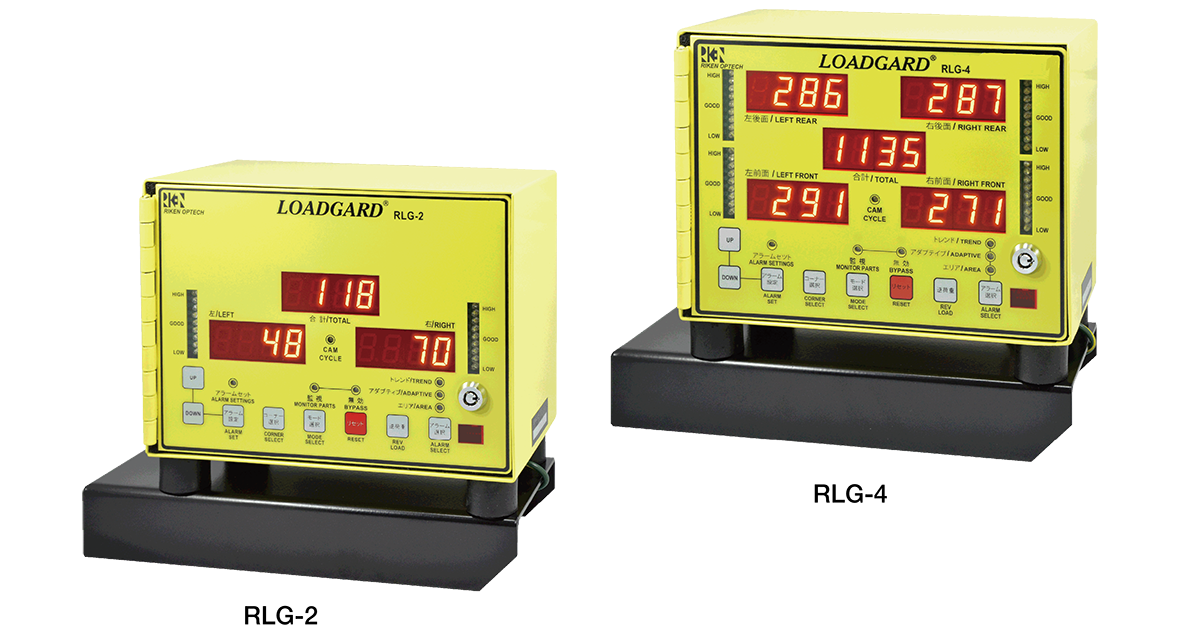
RLG series load monitor has the function of detecting the press load with a strain gauge. It displays the accurate load during press processing, and output stop signals and stops a press machine immediately when abnormality is detected. Multiple detection modes incorporated cannot be ignored when there are eccentric loads for each stroke, and furthermore, load monitoring extends the life of dies, prevents friction and wear of presses, also promotes quality control and rationalization.
Features
- Monitoring overload
- Responding to eccentric load by monitoring left and right separately
- Comparing load every stroke shows the effect for preventing die failure caused by double-hit and misfeed
- Respond to estimate the regrinding period of the die and changes of material thickness
- Two functions, “Absolute-value detection” and “Rolling average detection” are incorporated
- By knowing the suitable load for products, the selection of the press machine is facilitated
- Digital LED and bar display show the currant load condition clearly and easy to understand
Additional function in option (PC Software, Mariner AD)
- Load waveform analysis (load waveform analysis software, Mariner AD)
- Display peak load history
- SPC chart display function (statistical process management)
Multiple alarm functions incorporated high performance automatic Load Monitoring System
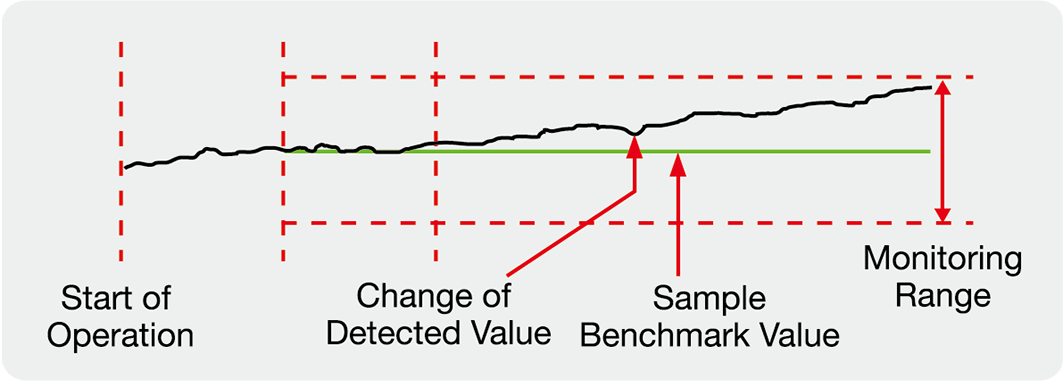
◎Trend (absolute-value comparison) Peak Detection
Monitoring conducted by setting the percentage using the sampling tonnage as the reference value.
This detection method always makes comparisons using the reference value.
Detection of accuracy required, such as that required during coining and engraving, is possible.
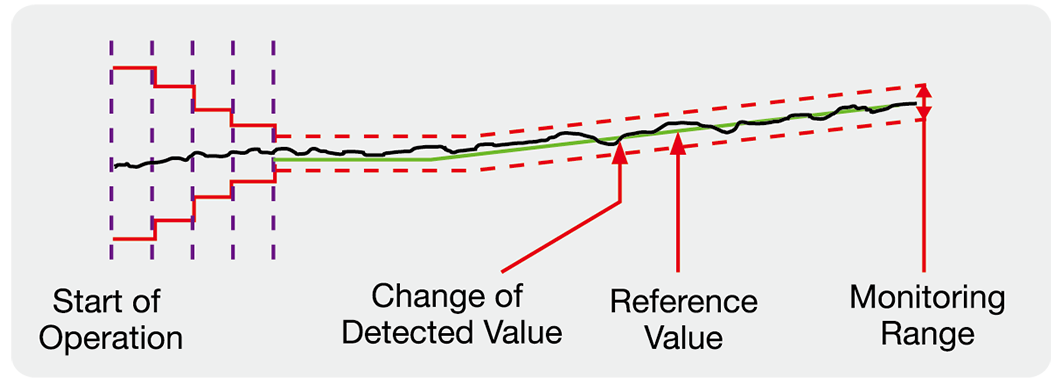
◎Adaptive (average-value comparison) Peak Detection
Monitoring conducted by setting the percentage using the updated rolling average value of tonnage continuously measured in several strokes.
This function enables to detect properly, canceling the effect of changes in materials, temperature, oil, etc.
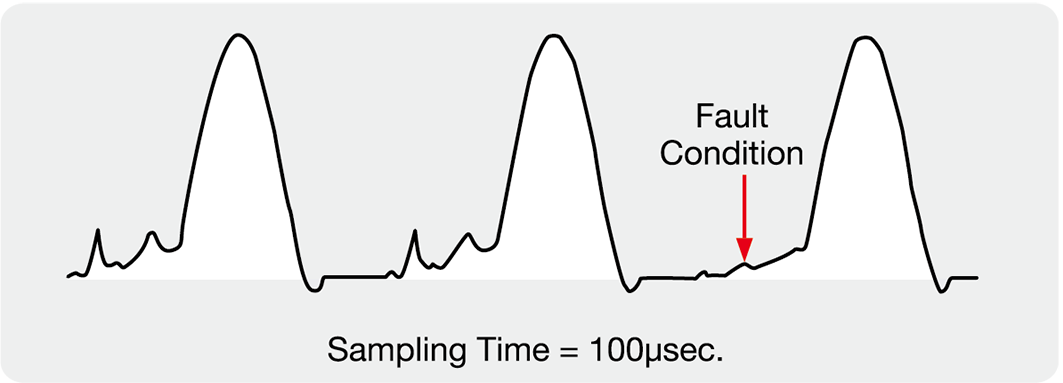
◎Area (energy volume comparison) Stroke Detection
Monitoring conducted by setting the percentage using the reference value of the load waveform area continuously measured in several strokes.
Various changes other than peak value can be detected.
Also broken punches, scrap clogging, scrap accumulation, etc., are detectable.
Expected Benefits of Introduction
- Die protection
- Press machine protection
- Visualization of processing load (Optimal load management)
- Reduction of setup time
- Increase operating rate and productivity
- Product quality control (detection of defective products)
- Predicting die maintenance timing
- Measuring breakthrough (reverse load) during punching
Load monitoring offers many benefits and is extremely effective in reducing costs.
Specifications
| Electrical Specifications | Power supply | 90-264 VAC |
|---|---|---|
| Current consumption | 100mA-220 VAC / 115mA-200 VAC | |
| No.of channels | 2 channels(RLG-2) / 4 channels(RLG-4) | |
| A/D conversion method | 12 bit | |
| Normal mode rejection | 50db at 2,000 gain (between + innput and – input) | |
| Calibration | Manual calibration | |
| Isolation | 500VDC continuous between inputs and chassis ground | |
| Environmental Specificatins | Working temperature | 0°C-60°C(32°F-140°F) |
| Input Specifications | Input type | Strain gauge (350Ω, 700Ω) |
| Input impedance | 1K | |
| Low range gain | Max. gain 1176 | |
| Cal. resistor(140k-ohm) | Min. gain 54 | |
| High range gain | Max. gain 6959 | |
| Cal. resistor(1meg-ohm) | Min. gain 347 | |
| Display resolution | Up to 0.1% of full scale | |
| Overall module accuracy | 1% of full scale | |
| A/D sample rate | 100 microseconds | |
| Output Specifications | Alarm relay | Dry contact (10A 240VAC) |